Ennenda
Ernst Reto Baltiswiler, professionally known as Ernesto Baltiswiler, is a Swiss artist, born in Glarus, Switzerland on January 2, 1961, the first child of Ernst Baltiswiler and Rosmarie Zurschmiede. His mother later named him “Ernesto” to be able to distinguish between her husband and her son who both had the same first names.
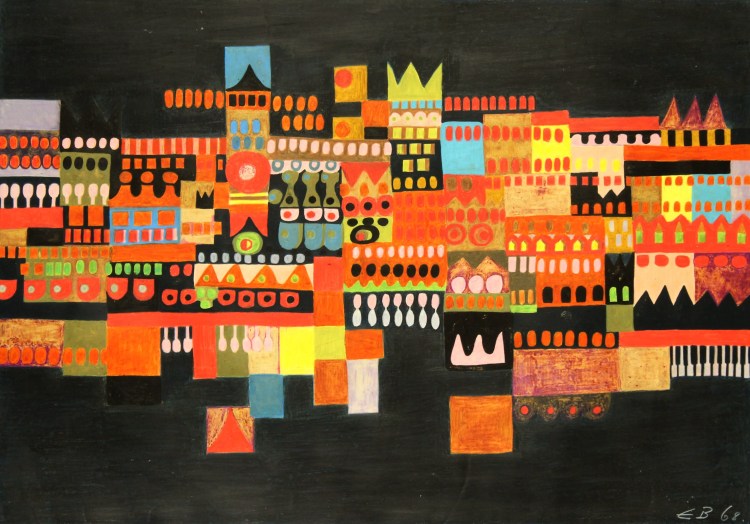
Raised in the small village of Ennenda amidst the Swiss mountains, he graduated with the Swiss High School Certificate “Matur”. From an early age he developed a keen interest in drawing, which was encouraged by his father who was a talented textile designer, who designed the 37 m² carpet “Swiss Orient” with 44 (!) different colours in 1964.
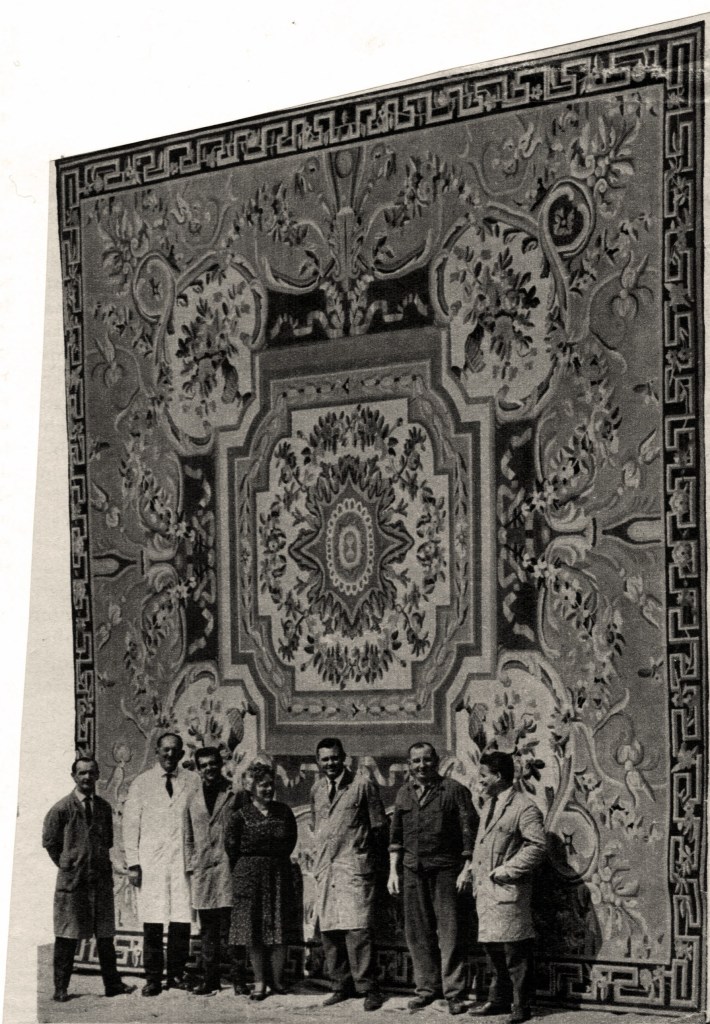
The carpet was made for the 600 year old patrician “Béatrice-von-Wattenwyl-Haus” which is a town mansion in the Old City of Bern, used as the official town residence for ceremonial events by the Swiss Federal Council.
Ernesto Baltiswiler
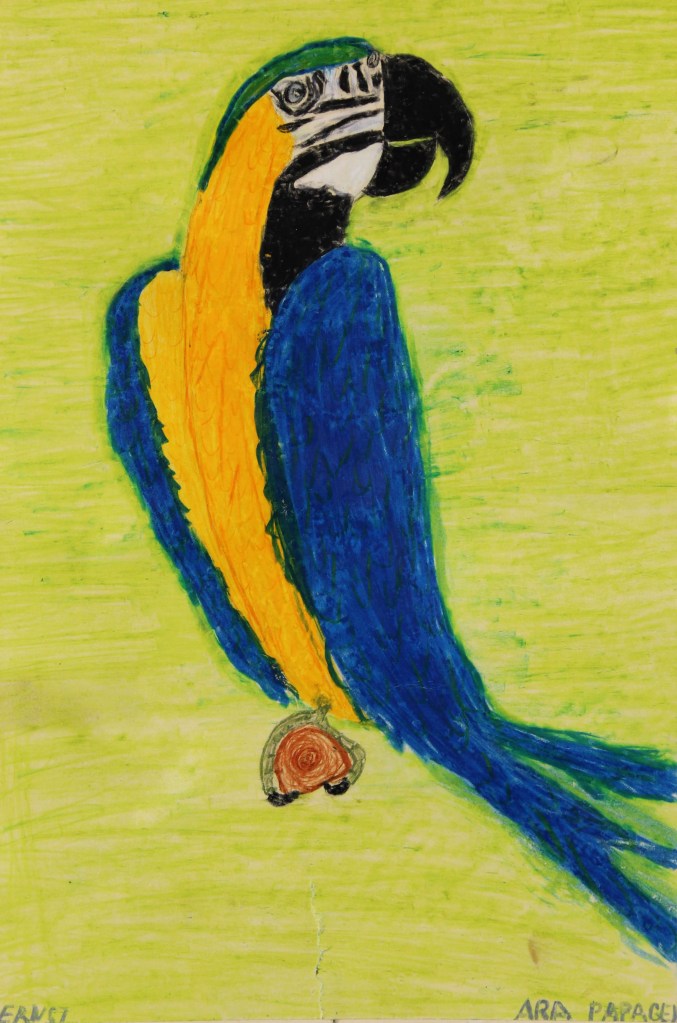
“I remember how I was often drawing together with my father when I was young. We could keep on drawing for whole weekends”
In October 1980 Ernesto Baltiswiler wrote an article “Schwierigkeiten im Umgang mit zeitgenössischer Kunst”, “Difficulties in dealing with contemporary art“, which was published in the local newspaper. In this article he cited his idol, the artist Joseph Beuys. Only half a year later, on April 7, 1981, he had the opportunity to meet Joseph in person together with his wife Eva, his daughter Jessica (b. 1964) and his son Wenzel (b. 1961) in Rome.
“Beuys had an exhibition where he displayed his sculpture “Terremoto” in a backyard at Palazzo Braschi, which I stumbled across on my Italian trip to Rome and Ischia, a volcanic island in the Gulf of Naples. Afterwards, I was able to speak a few words with Joseph. I asked him if he thought it was necessary to study in an art school or academy to become an artist? He didn’t have much time to answer my question since there were many people in the audience who also wanted to talk to him. But I got the unique opportunity to have long and very interesting conversation with his wife Eva. I learned a lot about what it meant to be an artist, especially a world-famous artist.
One year later I stumbled across Andy Warhol at an opening in PS1, New York and we also spoke to each other. Beuys and Warhol were at that time considered the most influential artists in the world. It was an amazing experience for me, as a very young artist, to meet both the artists within one year. It wasn’t planned, it just happened by lucky accident”.
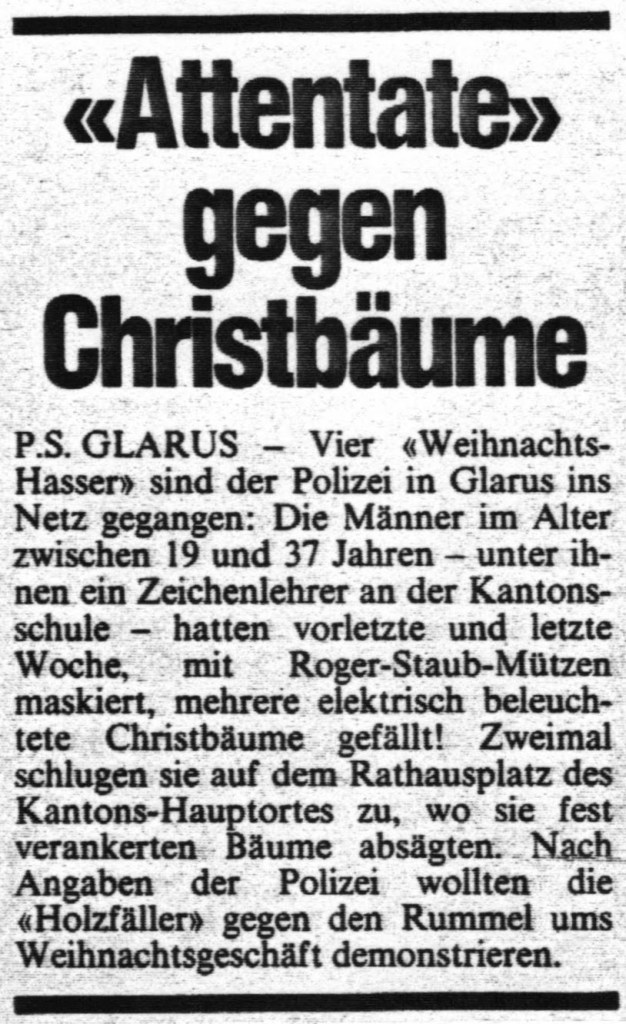
On July 7, 1981 Baltiswiler had to appear in court in Glarus, actually the same court where 200 years ago Anna Göldi “The last witch” was sentenced to death for witchcraft and executed by decapitation on June 13, 1782. Baltiswiler had to appear in court charged with criminal damage to property and disorderly conduct, together with three of his friends. They were each sentenced to pay a fine for the criminal damage to property but were discharged from the disorderly conduct charge. In December 1980 Baltiswiler and his friend Enrico Smaniotto were cutting an already cut public Christmas tree, in front of the government building. Two other friends had cut another already cut Christmas tree in front of the church one week earlier. One of them was Baltiswiler’s former art teacher. Half a year later the local newspaper’s headline on the front page was “Christmas tree cutters fined in midsummer”. While only a very few people could laugh about it as a joke, most of the locals were extremely upset and saw it as a vicious joke or even a terrorist act against the State and the Church. The incident made really big waves. Letters from readers were published in the local newspapers almost every day for half a year.
“We did it initially as a prank but our actions also revealed a kind of hypocrisy because the shopkeepers’ organisation who paid money to put up the trees, did so to attract people to come to Glarus for Christmas shopping and not to create a Christmas atmosphere in the first hand.
It was obviously time for me to leave the mountains. In 1981 I moved to the nearest city, Zurich and less than one year later moved further, to “the Big Apple”, New York City.”
Zurich
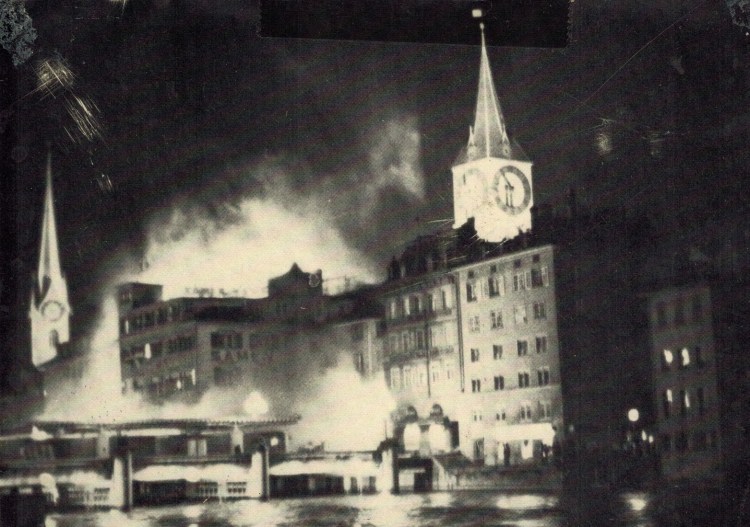
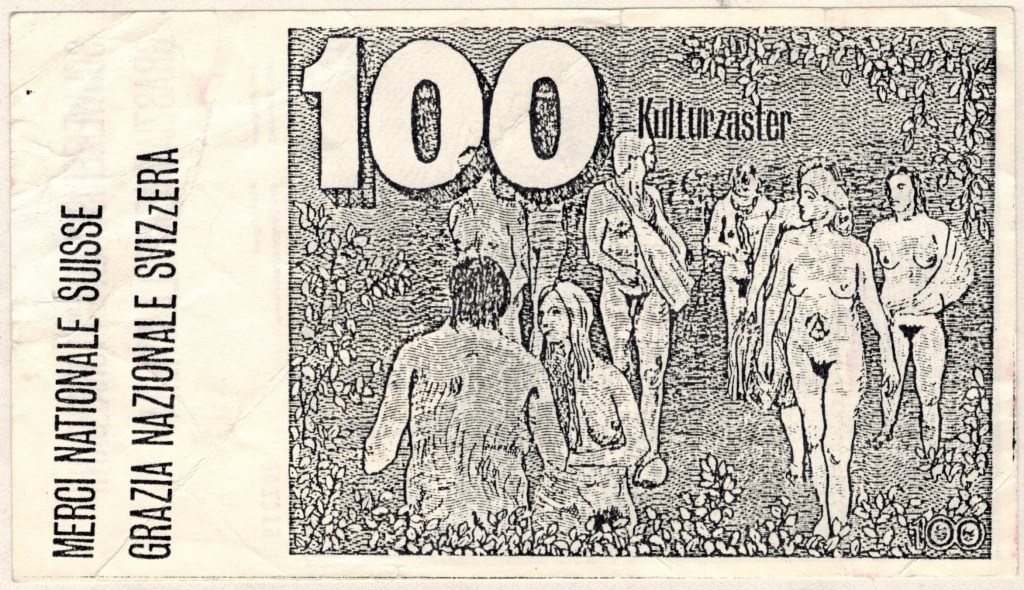
10 Rp. pro Karte für das AJZ, Foto: Kobau
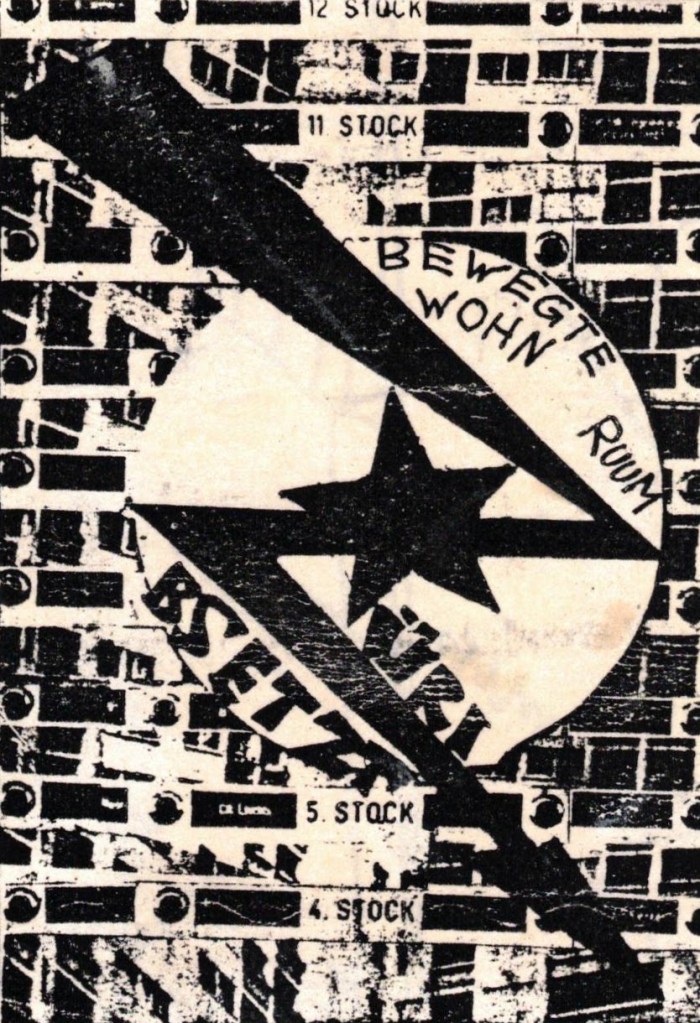
“When I moved to Zurich at the beginning of 1981 the youth protest movement “Zurich Opera House Riots” was in full swing. I became part of the movement and we called it “Bewegig” which simply means “movement”. The riots started in May 1980 as protests against the extremely high subsidies for the Zurich Opera by the city, while alternative cultural programs for the youth were completely neglected. Many young people felt that the line had been crossed and they wanted to express their frustration by demonstrating. There was at least one demonstration every week. Many were very humorous but some were violent. It was a very special atmosphere. On the one hand, there was a highly creative spirit among young people and on the other hand, there was a lot of police brutality and repression from the politicians who were unable to manage the situation. Several young people lost an eye from rubber bullets shot by the police.
I took part in many “demos” as a peaceful demonstrator but I still had to be very careful not to get caught by the police, because you could be sure they would beat you up at the police station. I had a girlfriend and she was a militant activist, burning and overturning cars and even throwing stones at the police.“
“From the Zurich riots in 1981 I still remember the smell and the burning of teargas in my eyes, or hiding and fleeing from the police. I was often frightened. Besides the cat-and-mouse-game with the police, there was a very creative atmosphere in the air, which I loved. The whole city of Zurich was fully sprayed with absurd, funny and Dadaistic quotes”
“Many demonstrations however were peaceful and full of humour, like the one when all the demonstrators were walking naked and on another occasion, the demonstration took place swimming in the river Limmat in the middle of the town. Xerox fliers were frequently printed like the ones titled “Macht Gurkensalat aus dem Staat” which means “Make cucumber salad out of the state” or “Freiheit für Grönland” which means “Freedom for Greenland”.
All together it was an incredible atmosphere of departure, which was a big relief for me after all the years in the mountains, where I often felt restrained among narrow-minded locals.”
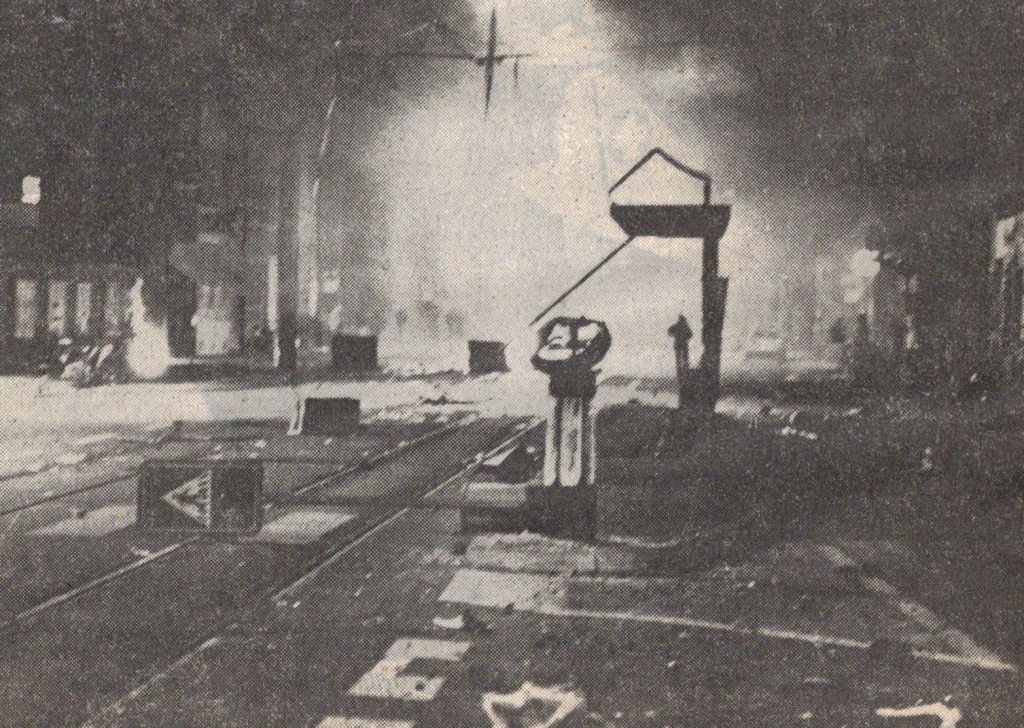

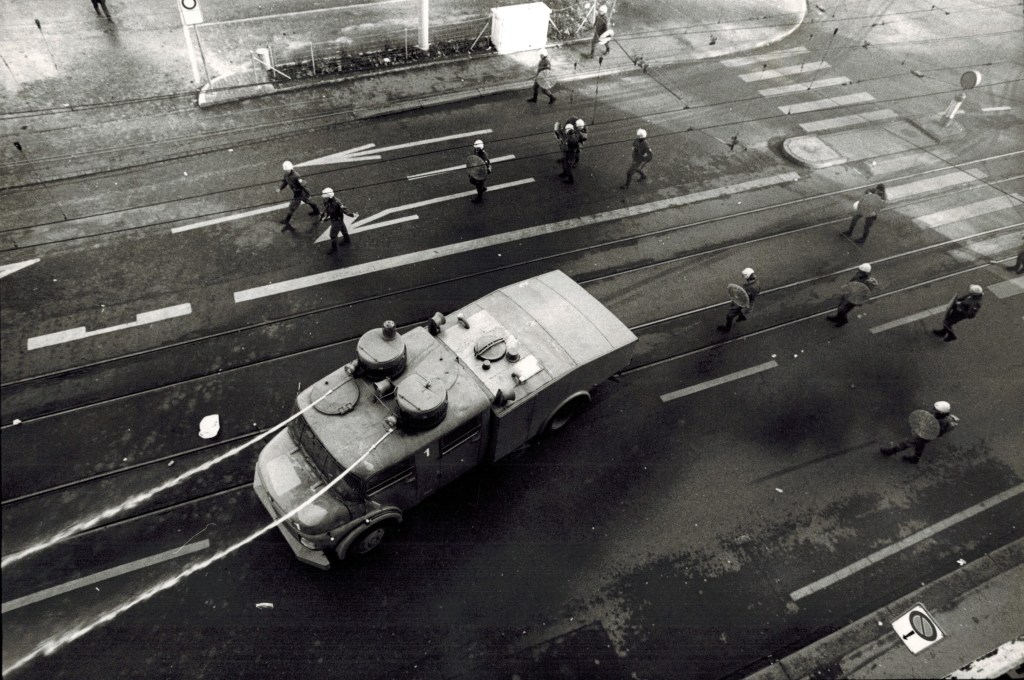
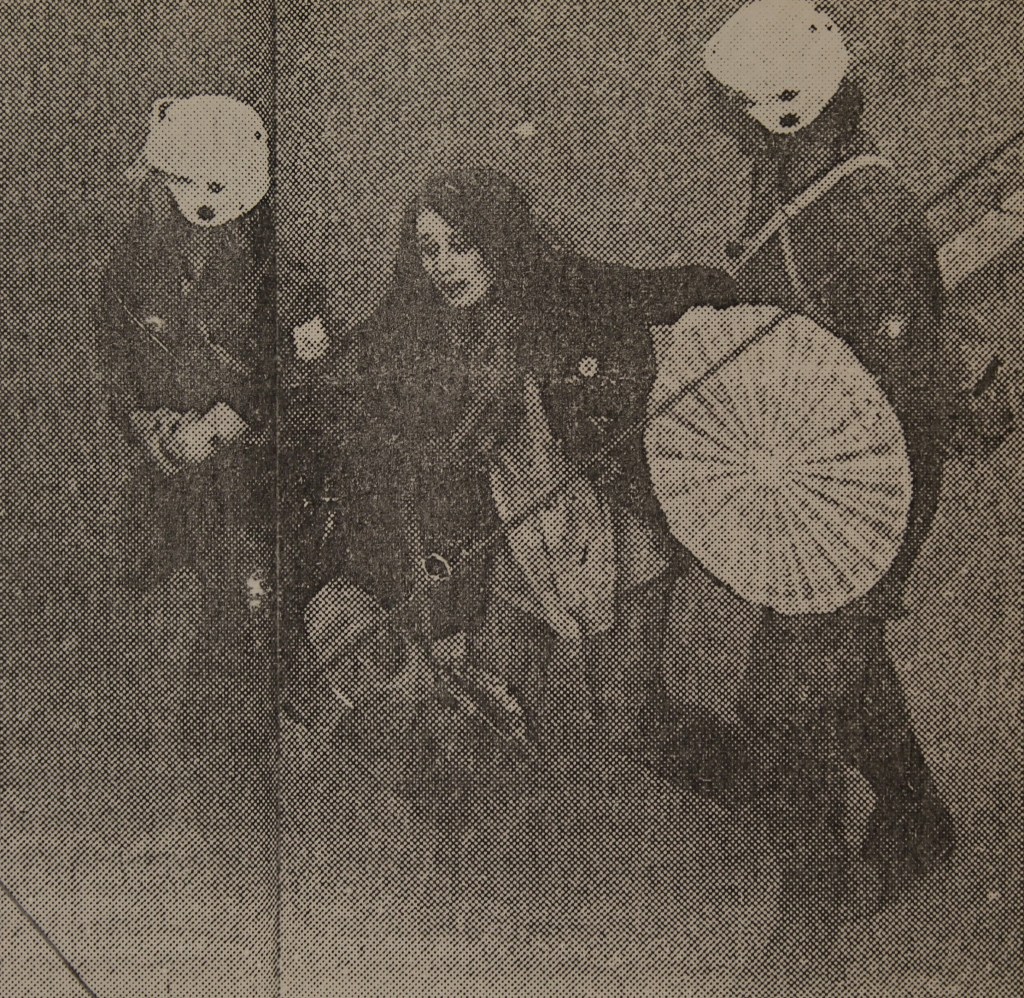
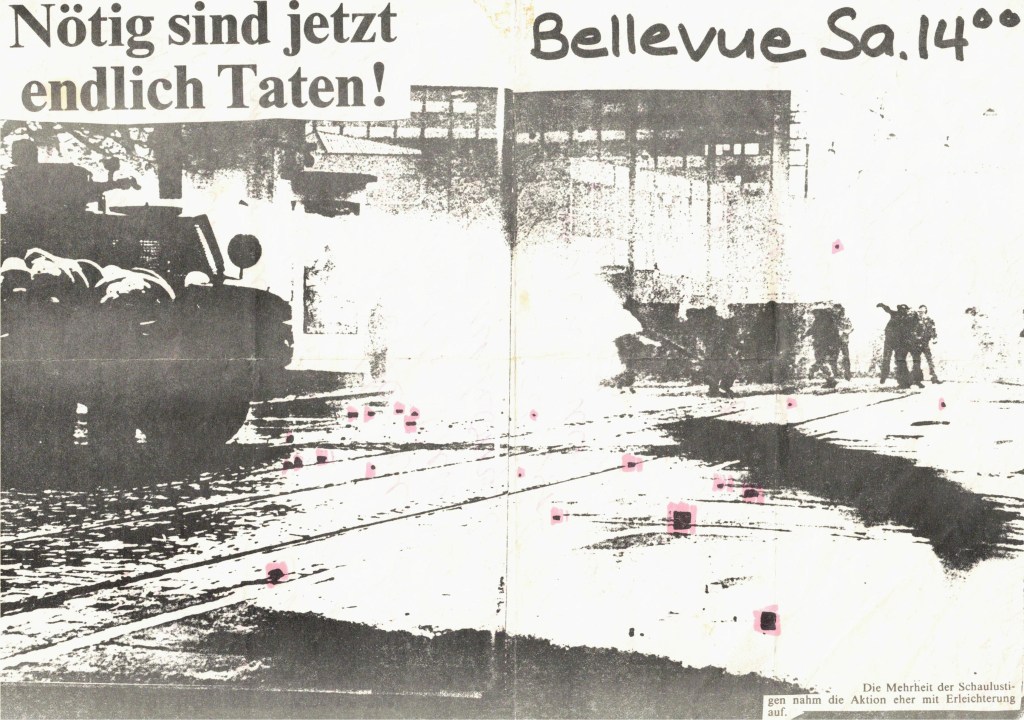
“A person who knew me and worked for the big publisher Ringier in Zurich, asked me if I wanted to be a model for a photo shoot. They wanted to make a report about the youth movement in their weekly magazine “DIE WOCHE”, “THE WEEK”. I agreed although I didn’t consider myself as a typical representative and in some young people’s mind I was considered a betrayer because I was willing to work together with a big capitalistic and conservative publisher. Alberto Venzago took the photos. He would later become a renowned photographer. October 2, 1981 the magazine was published with my portrait on the front cover, hanging outside every kiosk all over Switzerland. The magazine died shortly after.”

Photo: Alberto Venzago
“The same year the cult documentary movie “Züri brännt”, meaning “Zurich is burning”, about the riots was released. I saw the film at the premiere in a cinema in Zurich together with the German conceptual artist Jochen Gerz who I got to know a short time before. We were very touched by the film.
I often spent time in the AJZ centre, “Alternatives Jugend-Zentrum”, the “Alternative Youth Centre”, close to Zürich’s main station, a short-lived centre which the movement got as a compromise from the city. There you could get a good and cheap meal, listen to concerts in the evening and meet all kinds of people. I met the Swiss painter Martin Disler. We became friends and he invited me to his studio where I visited him a couple of times. He was a very productive and successful painter at that time. He introduced me to his former girlfriend, the gallerist Elisabeth Kaufmann.”
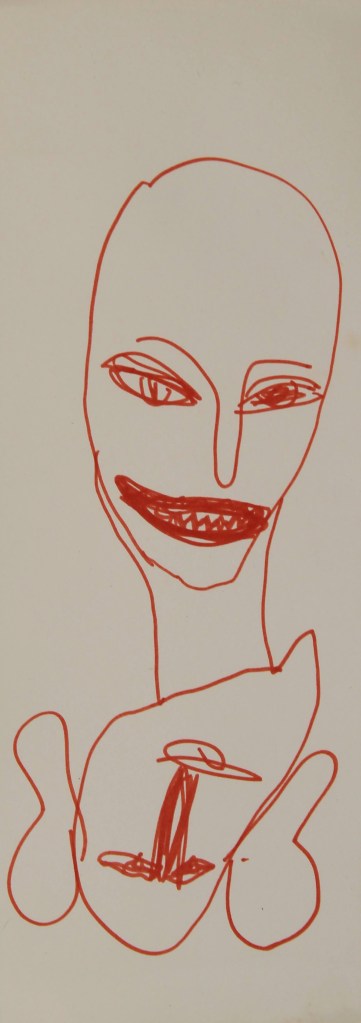
Gift from Martin Disler to
Ernesto Baltiswiler
“Early that year, a good friend of mine introduced me to the curator Bice Curiger. We lived around the corner from each other for a while. I met her a couple of times in the following years and she helped me to discuss my art work.
I met a whole bunch of Zurich’s artists. I became friends with Peter Fischli, a couple of years before he started to work together with David Weiss and became world-famous. One day, when I came up the stairs where he lived, I entered his apartment and found him sitting in the bathtub. He told me that even artists have to take a bath sometimes. I liked his humour.
I regularly spent time with the artist Anton Bruhin. He was a funny guy, a real Zurich Dadaist, always wearing a suit and a bow tie. I had the feeling he knew everybody in town. His studio was in the very centre of Zurich near the Paradeplatz. He was very creative, full of fantasy, constantly drawing, making music with his jaw harp and reciting poems he made up.”
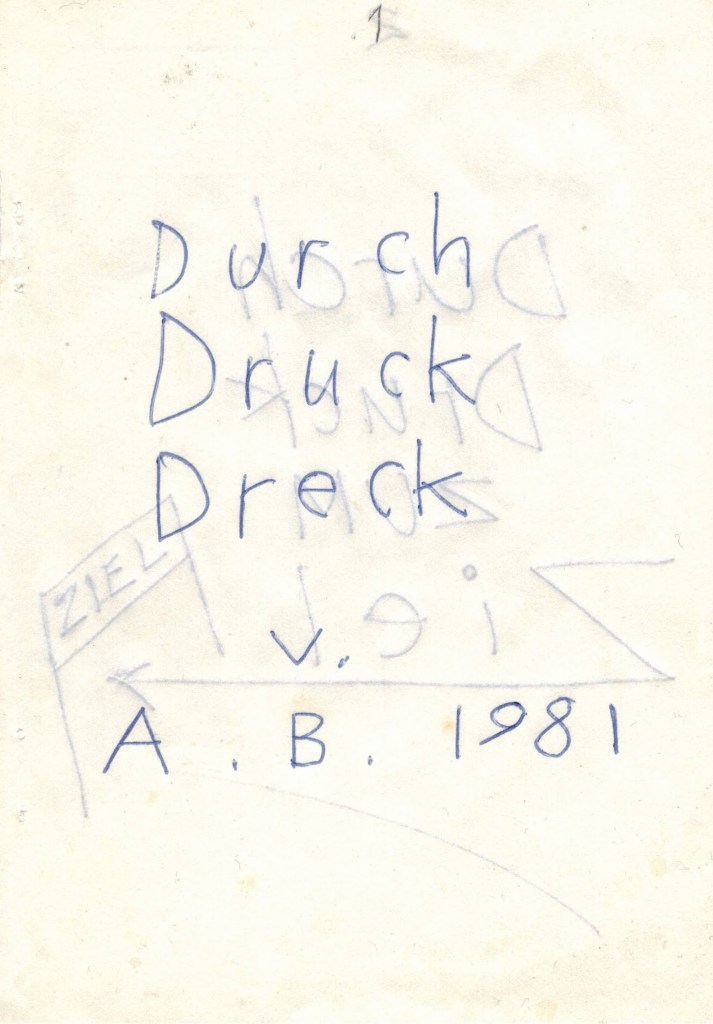
15 x 10.8 cm, Zürich, 1981
Gift from Anton Bruhin to Ernesto Baltiswiler
“And I stumbled across Klaudia Schifferle. We sometimes met in the bathhouse Utoquai at lake Zurich together with Stephan Eicher, who was her boyfriend then. She was a quite well-known artist and punk musician in the women’s band Lilliput, while the musician Stephan was yet completely unknown.”
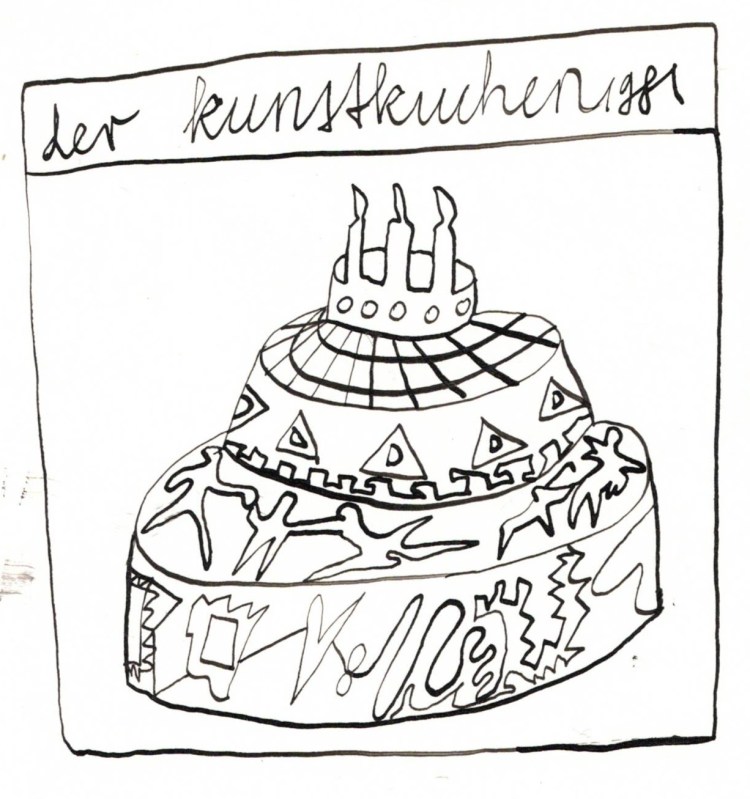
from the arstist book “ZURich”, Ernesto Baltiswiler
“And of course, I became friends with Andreas Züst outside the artist’s bar Kontiki in Zurich’s old-town. He knew hundreds of artists. With his camera always hanging on his shoulder, he constantly took pictures of artists and friends in all kinds of funny situations. He was a good friend to Sigmar Polke and he told me that Polke had promised him a painting, which he never dared to ask for when he sometimes met him in Cologne.”
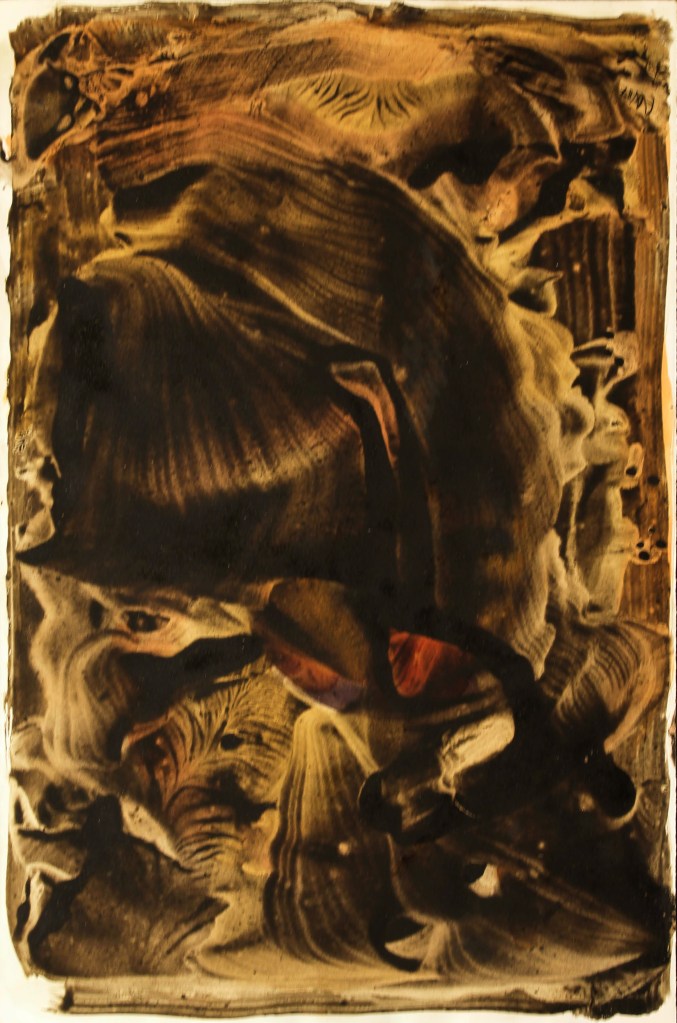
Gift from Andreas Züst to Ernesto Baltiswiler
“Together with his friend the art critic Patrick Frey, they published two photo books “Bekannte Bekannte/ Famous Acquaintances I + II, in which I was a part too. We spent a lot of time in his country house “Spiegelberg ” outside of Zurich. Later in 1990 we made a trip together to Svalbard and not long before he died of a heart attack in his garden in 2000, we crossed seven Swiss mountain passes in his old Jeep, in one day. His favourite phrase was: “Da seichsch in Ofä” which means “And there you piss in the oven.”
The art critic Patrick Frey and I became friends. We later lived close to each other in Zurich’s Kreis 5 and even later he became a very well-known comedian in Switzerland. He bought several of my paintings and works on paper.
In March 1981, Anton Bruhin took me to the Winterthur art museum to prepare the exhibition “Bilder”/ “Pictures” with a few other Zurich artists: Anton Bruhin, Martin Disler, Olivia Etter, Peter Fischli, Urs Lüthi, Josef Felix Müller, Walter Pfeiffer, Klaudia Schifferle, Anselm Stalder, Francois Viscontini and David Weiss. I got to know all of them. Peter Fischli and David Weiss were still exhibiting separately. They were not an artist duo yet. Anton Bruhin made a huge painting in the museum’s entrance hall in which I was part of the painting process with a few brushstrokes.”
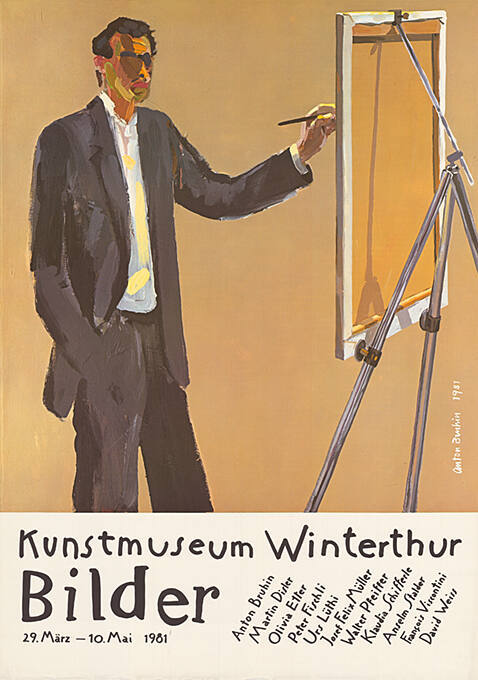
“And I met Max Bill who lectured on art at the University of Zurich and I joined his class for a while. He had studied at the Bauhaus and had teachers like Wassily Kandinsky and Paul Klee.”
In 1981 Baltiswiler made his first serious artwork, the painting “Odysseus” inspired by the story of the Greek poet, Homer. The story symbolizes the ups and downs and threats in human life and ends when Odysseus finally meets Penelope, the love of his life as an old man.
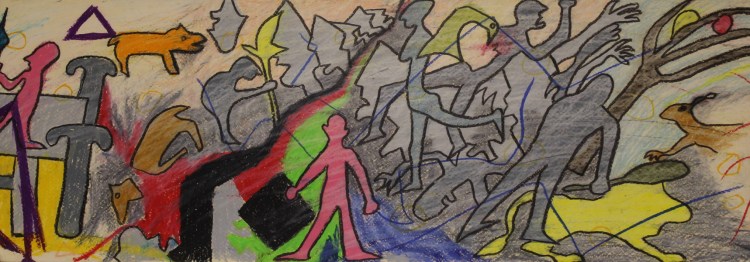
Baltiswiler was inspired by the style of the new emerging painters “Die Neuen Wilden”, “The New Savages”. They were four artists from Cologne and called their artist group “Müllheimer Freiheit”. They became known for their large and expressionist paintings.
Baltiswiler’s colourful work was also large but in a different sense, 14 meters long but only 21 cm high. One of the artists of the “Müllheimer Freiheit” group, Peter Bömmels, Baltiswiler met half a year later in New York and they then spent Easter together. Another member of that group, Jiri Georg Dokoupil, he later met in Düsseldorf.
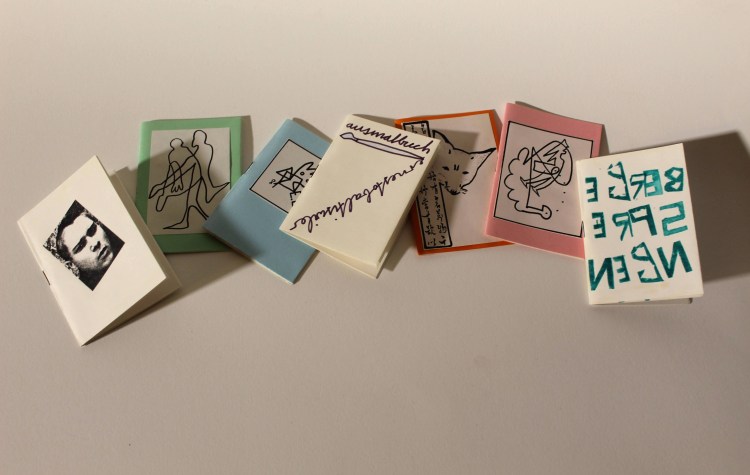
Baltiswiler made his first artist book “O.T.”, a limited edition of 50 copies, a cardboard book box set with 7 different booklets, handmade potato stamps, original drawings and xerox copies of drawings and texts. Baltiswiler sold the box on the streets of Zurich. The box is now part of the Art Library Rare Books Collection of the University of Louisville in the U.S. and it was part of the exhibition “Artists’ books in Switzerland” in Helmhaus Zürich in 1990.
The tensions and riots with the police got harder and harder. One of Baltiswiler’s friends died after being beaten up so badly by the police. Baltiswiler wanted to leave this repressive milieu. His new idea was to live in a global city. He applied for the School of Visual Arts in New York and was accepted to start on January 25, 1982. By now, Baltiswiler’s own odyssey had started. He arrived in New York City January 21, shortly after his 21st birthday.
New York City
On January 21, 1982 Ernesto Baltiswiler arrived in New York City wearing a mohawk hairstyle with a light green strip of upright hair and blue plastic shoes. He wasn’t aware that the indigenous people of the Mohawk nation who used to live in Upstate New York wore a similar haircut. The first month he stayed at a friend’s place in Wooster St. before he found an apartment at 355 E 4th St. at the corner of Ave D in the Lower East Side.
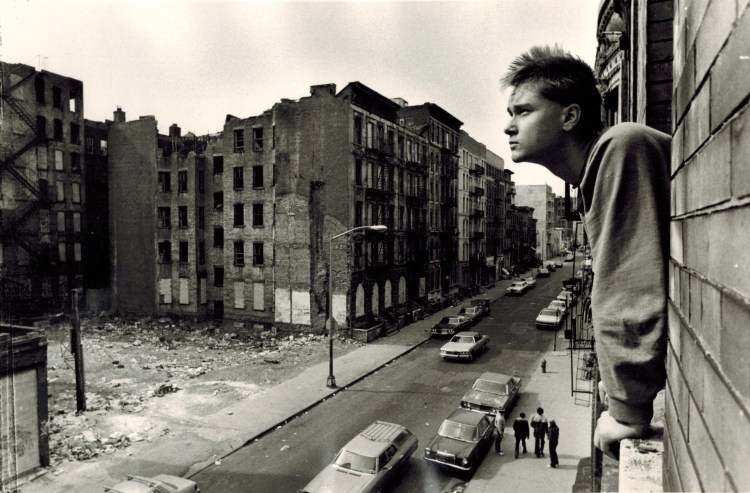
“I didn’t know if I should take the apartment or not since the Lower East Side was a dangerous area. But the little loft was so beautiful that I couldn’t resist. I could see the tops of the World Trade Centre but the neighbourhood outside looked like a war zone, with all the burned and ruinous houses. Junkies around the corner tried to sell me all kinds of drugs. It was a Puerto Rican area. People were speaking Spanish. You could hear the salsa music from the “ghetto blasters”. The entrance door to my house was full of gunshot holes. The Puerto Rican drug lord “Kojak” lived on the second floor and sold coke. I could only enter and leave the ghetto via 4th Street, where the gang knew me. When I passed the gang, they would shout “kikeriki” at me because of my mohawk haircut. Other gangs would have killed me if I had used their street. The gang members had no phones at that time. They would shout to a person nearby who would in turn, shout to the next. This was their communication system which worked very well for them. My white friends were so scared they didn’t even visit me during daytime, while my black friends would only visit me during daytime. You can imagine how scared I was when I came home late at night, passing the gang in my street and even more so, when I had spent all of my money on beers. The rule was that you needed to have at least 20 bucks on you, otherwise they would kill you.”
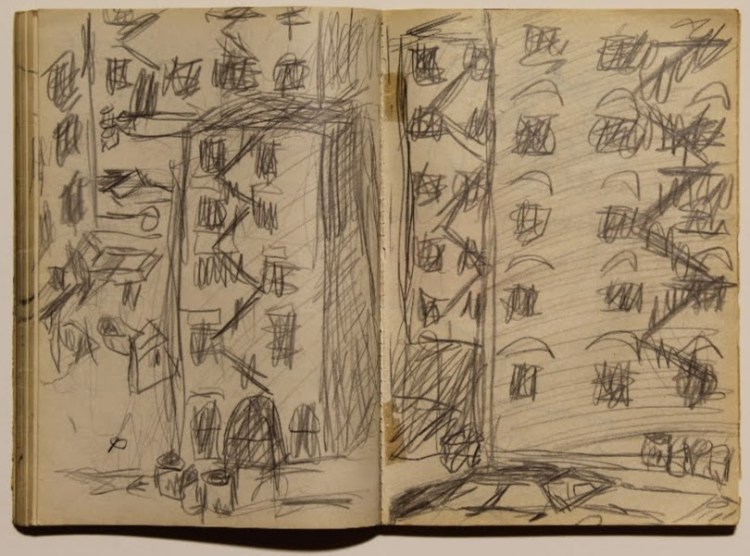
“New York City was absolutely overwhelming. I bought a “Walkman” and with my headphones on I would walk the streets among the high skyscrapers listening to “Forget Me Nots” by Patrice Rushen. The amazing stereo sound of New York City’s radio stations was incredible and totally new for me. I had arrived in the metropolis. I was a New Yorker.”
On January 25, Baltiswiler started as a new student in the Fine Arts Department of the School of Visual Arts at 209 East 23rd Street, New York. Keith Haring had just left the same school, or rather he was expelled, when he used the interior of an SVA building as a canvas for graffiti, in a project with Jean-Michel Basquiat.
” The whole subway was full of Keith Haring’s black and white graffiti which he had painted on the walls himself. It looked really great. He still wasn’t known at that time”.
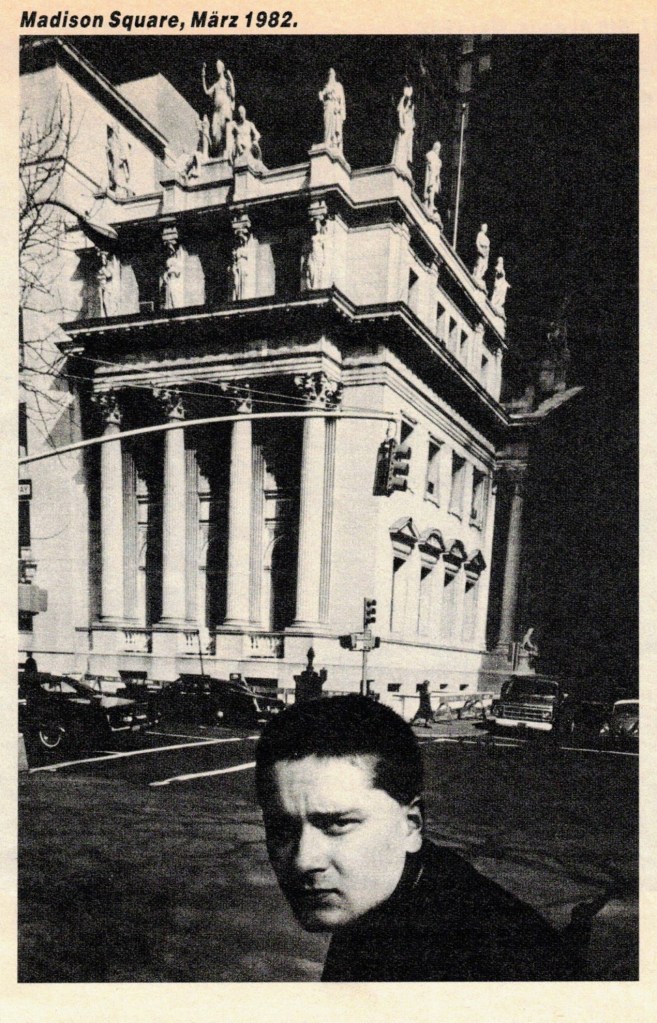
“SURVIVORS”, Ernesto Baltiswiler,
Madison Square, March 1982,
Photo: Thomas Frey
“Anton Van Dalen became my teacher for “Drawing” or more precisely nude drawing. He was a very nice guy and a close friend to Lou Reed. Together with his family, he lived in the East Village quite close to my neighbourhood. He was always willing to help me.”
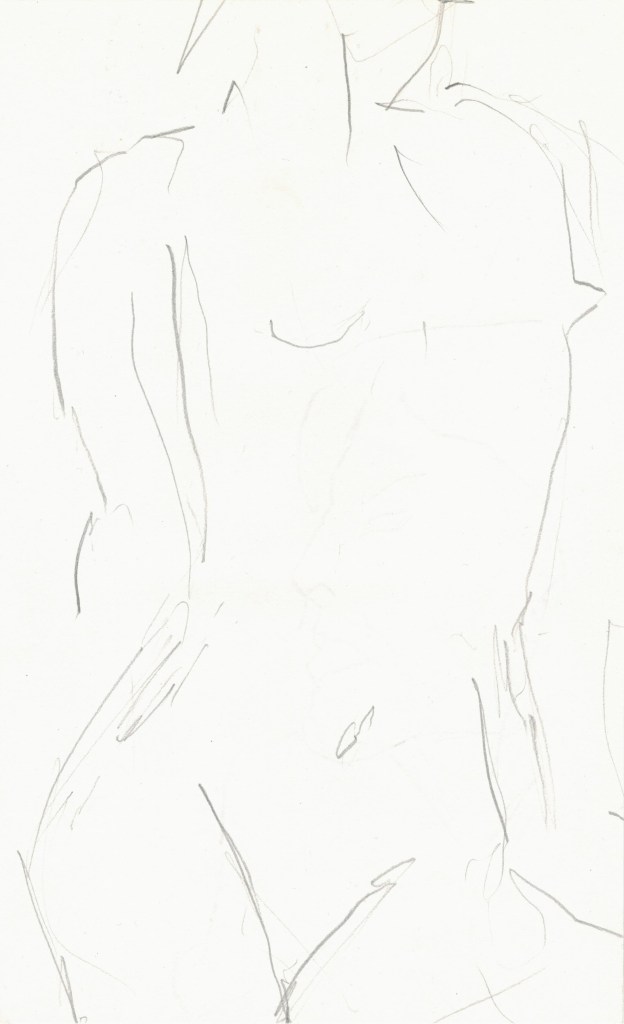
Ernesto Baltiswiler, New York City, 1982
“Larry B. Wright became my “Printmaking” teacher. Larry was a good friend and the assistant to Robert Rauschenberg. I made a couple of silkscreens and the very beautiful four colour lithography “Ischia” together with him. He was very good at printmaking. He invited our class to his big apartment uptown and told us that Bob had paid for him to go to a very expensive rehab clinic, to overcome his cocaine addiction.”
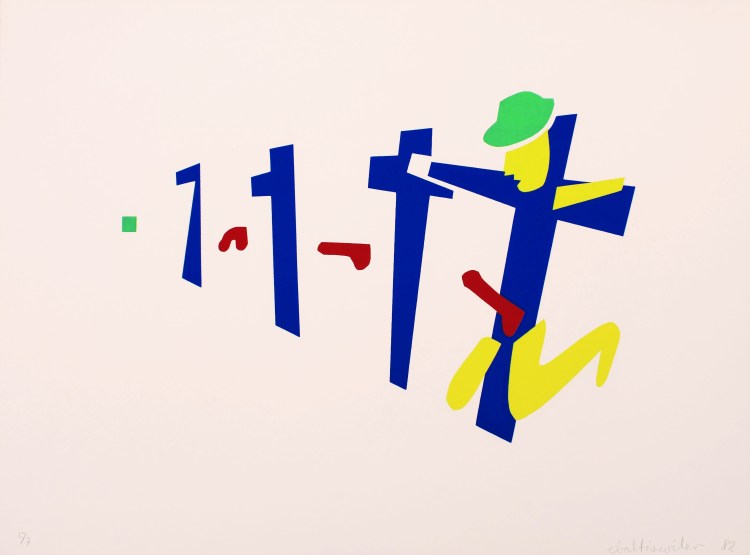
Ernesto Baltiswiler, New York City, 1982
“Alice Adams became my teacher in “Sculpture”. Alice was a very friendly lady. She liked my work. Unfortunately, I often ditched school and instead I wandered the streets of New York. But I made two very cool sculptures in her class, “The Monumental Woman” and “The Fried Egg”. “The Monumental Woman” was meant to be the opposite to the phallic skyscrapers. My sculpture was a model and should in reality be built as a huge horizontal sculpture. “The Fried Egg” looked really like a fried egg and was made out of copper and enamel.”
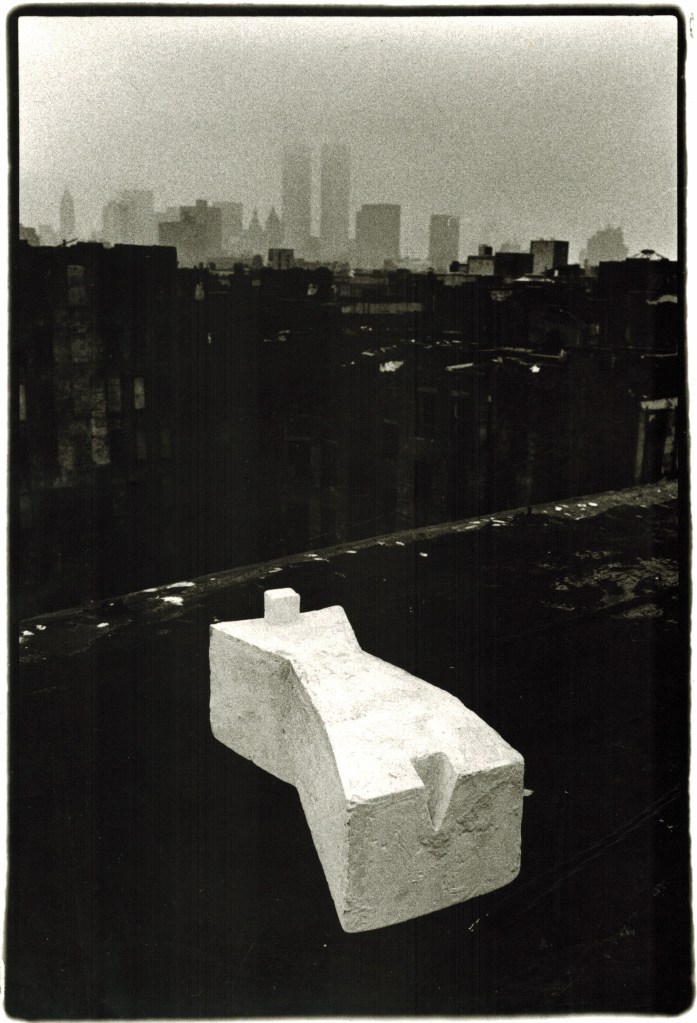
Ernesto Baltiswiler, New York City, 1982
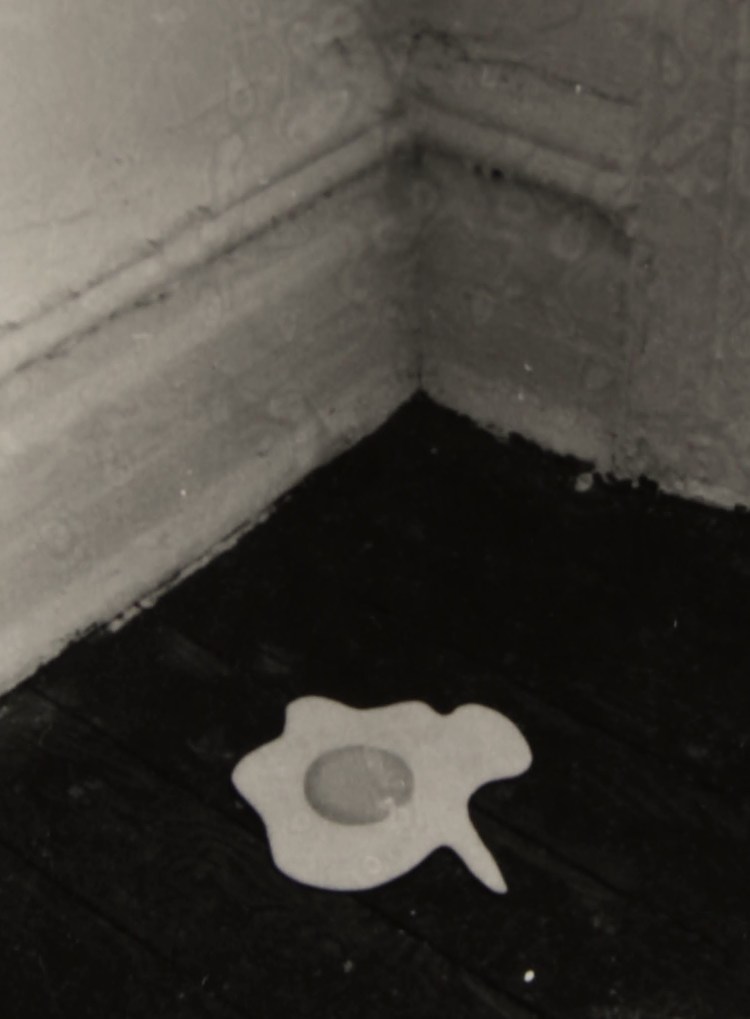
Ernesto Baltiswiler, New York City, 1982
“I also attended the “Photography” class and one day I stumbled across the photographer legend Robert Frank in Chinatown, together with the Swiss photographer Thomas Frey, who was a friend of mine. I didn’t even know who Robert was. Frank became world-famous with his photographic book “The Americans”, with an introduction by Jack Kerouac. He invited us to his downtown loft at Bleecker Street and asked us if we could paint his loft. So I visited Robert and his wife June a couple of times. I was able to spend some time together with this artist legend very privately. Robert could still speak some Swiss-German from his time in Zurich, when he learnt to become a professional photographer. We had discussions about art and I was very impressed by Robert’s spirit as an artist. This was an important experience for me as a young artist, far more important than every lesson in an art school. I also had good contact with his wife June Leaf who was a sculptor and a very warm-hearted person.”
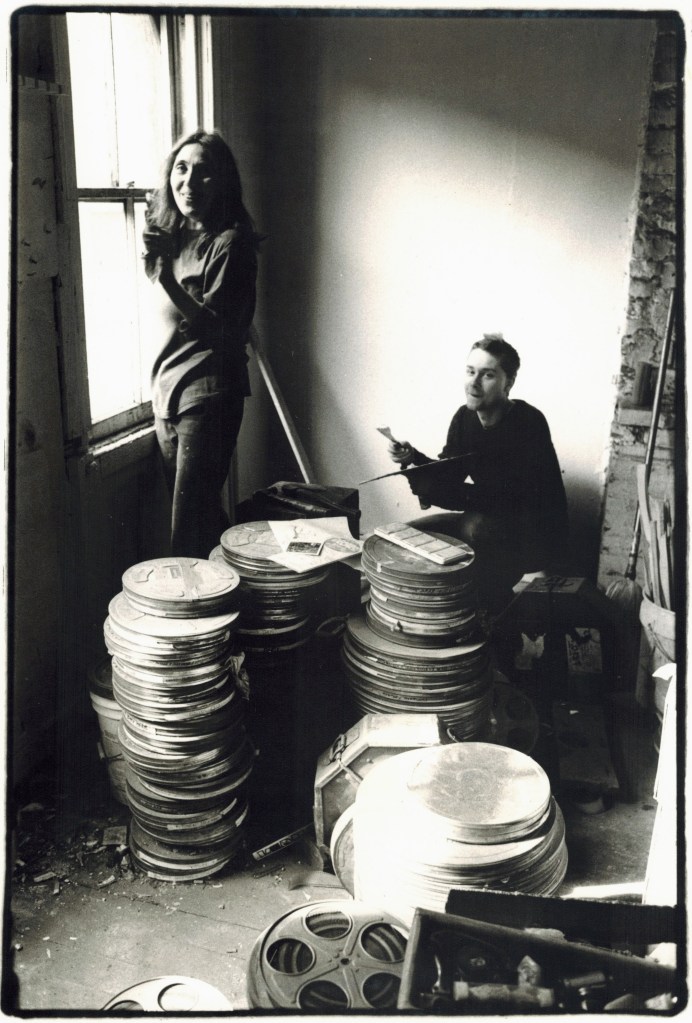
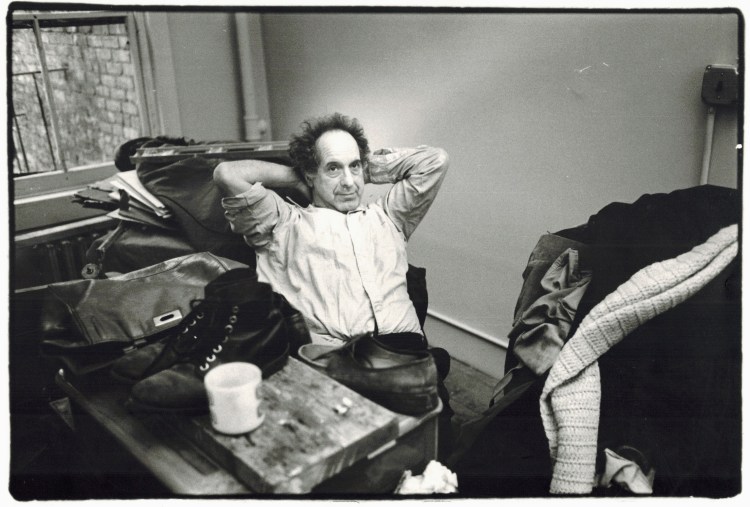
“I stumbled across a few more artists. I met Christo and Jeanne Claude at Lorence-Monk Gallery. We talked a few words.
And I met Tony Cragg for the first time, at his opening at Marian Goodman Gallery. We also talked a few words without knowing that he would become my teacher in the Kunstakademie Düsseldorf, one year later.
In the same gallery, I met Anselm Kiefer at his opening. We also spoke with each other. Unfortunately, I remember him as a very unpleasant and unfriendly person.
I spent Easter with my friend Tutu from Berlin and the artist Peter Bömmels from Cologne. Tutu was a close friend of the filmmaker Rainer Werner Fassbinder. When Fassbinder died later in June, I heard the news from Tutu even before it became public. Peter Bömmels was one of the four artists of the well-known artist group “Müllheimer Freiheit”. He was very happy when I gave him, as an Easter present, an egg moulded into gypsum so it became square.
Another of Tutu’s friends was the painter Bernd Koberling from Berlin. He had an exhibition in New York in an uptown gallery. When we met in a bar after the opening we became friends immediately. He was wearing brown leather shoes while I was wearing my blue plastic shoes. He wanted to change shoes with me but I didn’t accept. He told me about Iceland, where he lived besides Berlin and where he fished for salmon when he wasn’t painting. He was a trained chef. But when I met him, he was a professor of painting in Hamburg. He was often together with the Swiss artist Dieter Roth who also lived in Iceland and whom I would later meet in Düsseldorf. So, this was my first glimpse into the North with its nature, in the middle of a big city and I couldn’t have imagined that I would, 22 years later, live in the wilderness on a remote island in the North of Europe and do the same as him: painting and fishing. Berndt and I would later meet a couple of times in Düsseldorf together with many artists like Albert Oehlen in the Old-Town of Düsseldorf. When he had a few drinks he always stood on his head on a table in the middle of the club.”
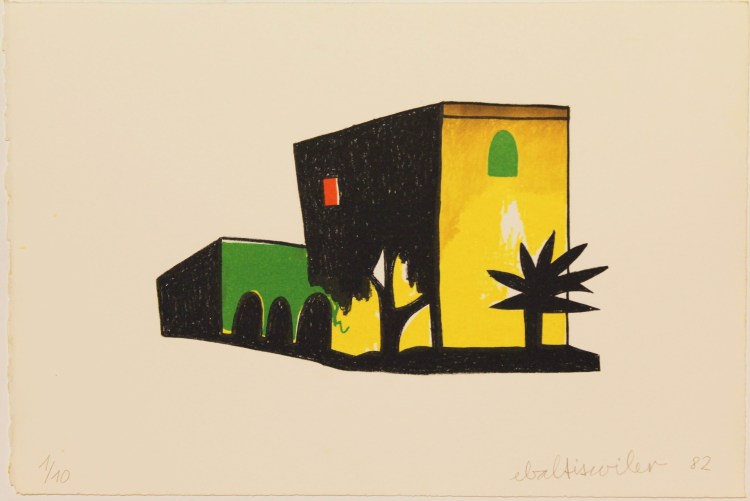
Ernesto Baltiswiler, New York City, 1982
And I met the painter Max Book from Sweden who had a scholarship to stay in PS1. I was fascinated by his strange paintings with motifs from Swedish nature. We would later meet in Stockholm and become friends.
After Joseph Beuys and Robert Frank, Andy Warhol was the third artist legend I stumbled across within one year. I met him at an opening in PS1 in Queens. It was crowded with people that night. I wore a woollen pullover I had designed myself and which a friend of mine had knitted for me, before I left Switzerland. Andy started to talk to me and I couldn’t believe who I had in front of me all of a sudden. He was short and he had a very weak voice. I thought he would fall apart at any moment. He took some photos of me. It was a magical moment for me, together with him in this huge crowd of art people.”

Although ditching school many times, Baltiswiler worked a lot at home. Beside the prints and sculptures, he made in The School of Visual Arts, he made six artists books: 500 PAGES, STADT statt LAND, ART AND, Gas & Goodies, N.Y.C. presents New York City and The New York Times.
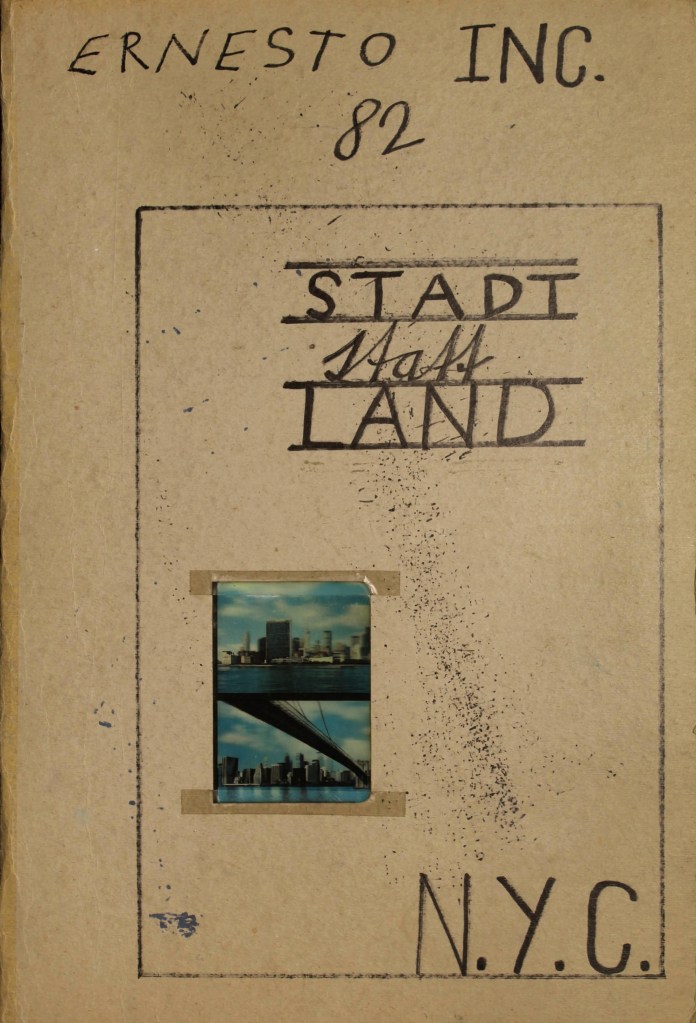
artist’s book
Ernesto Baltiswiler, New York City, 1982
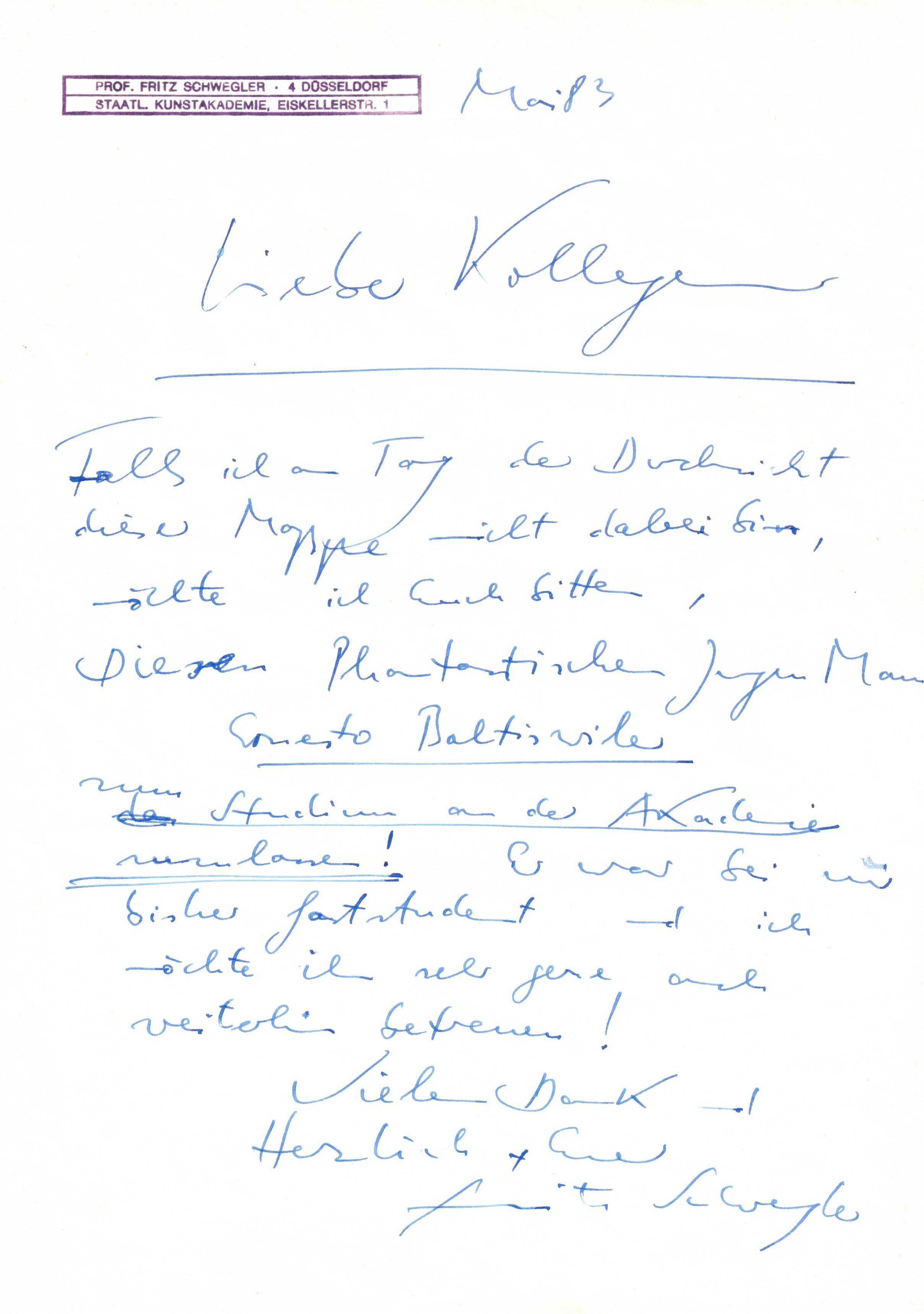
A student from the Kunstakademie Düsseldorf who had a scholarship in New York, persuaded Baltiswiler to change school to the art academy in Düsseldorf, which was supposed to be the best art school in the world, at that time. Baltiswiler wrote a letter to Fritz Schwegler who was a professor and asked him if he would admit him to his class. Fritz Schwegler was known for his artists’ books. Schwegler accepted Baltiswiler’s request.
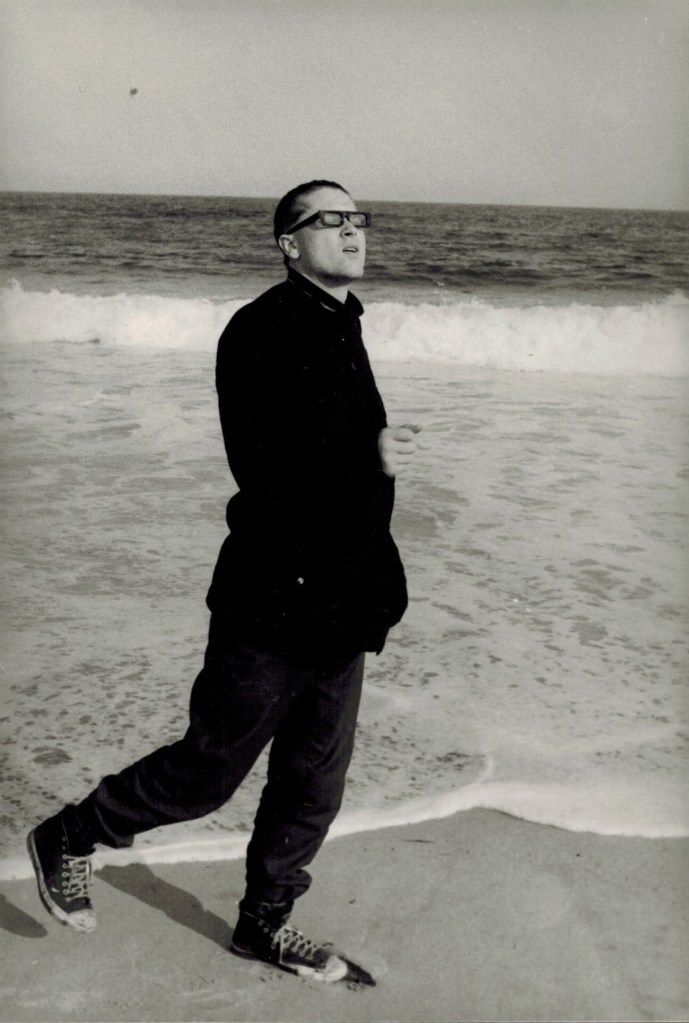
New York, 1982
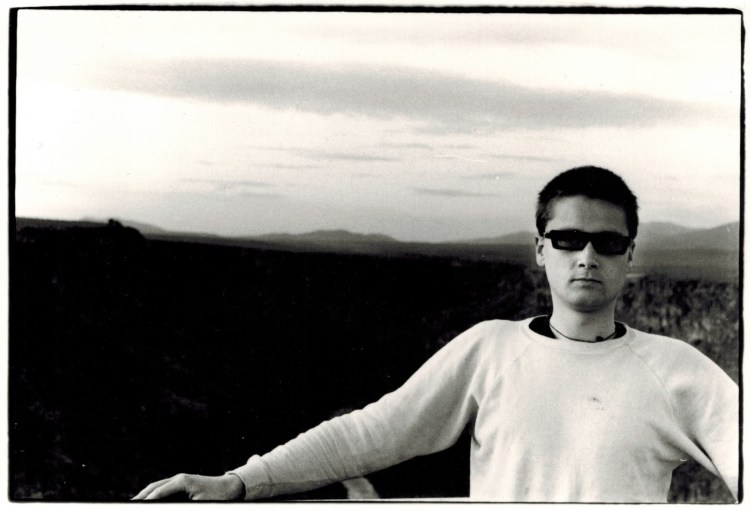
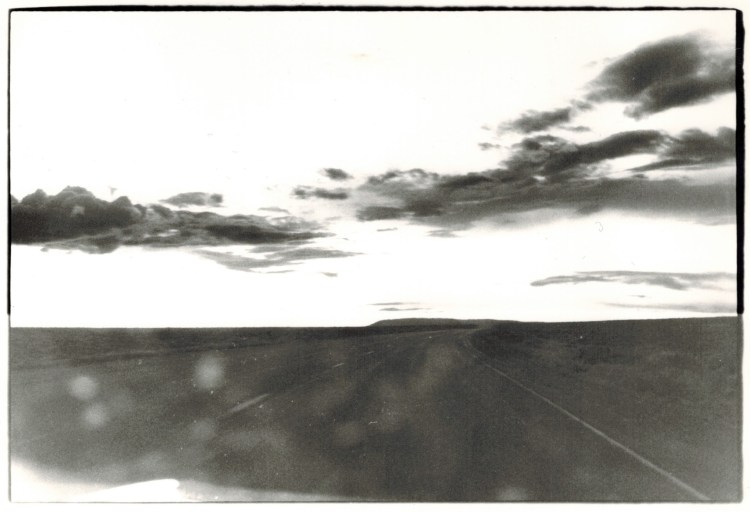
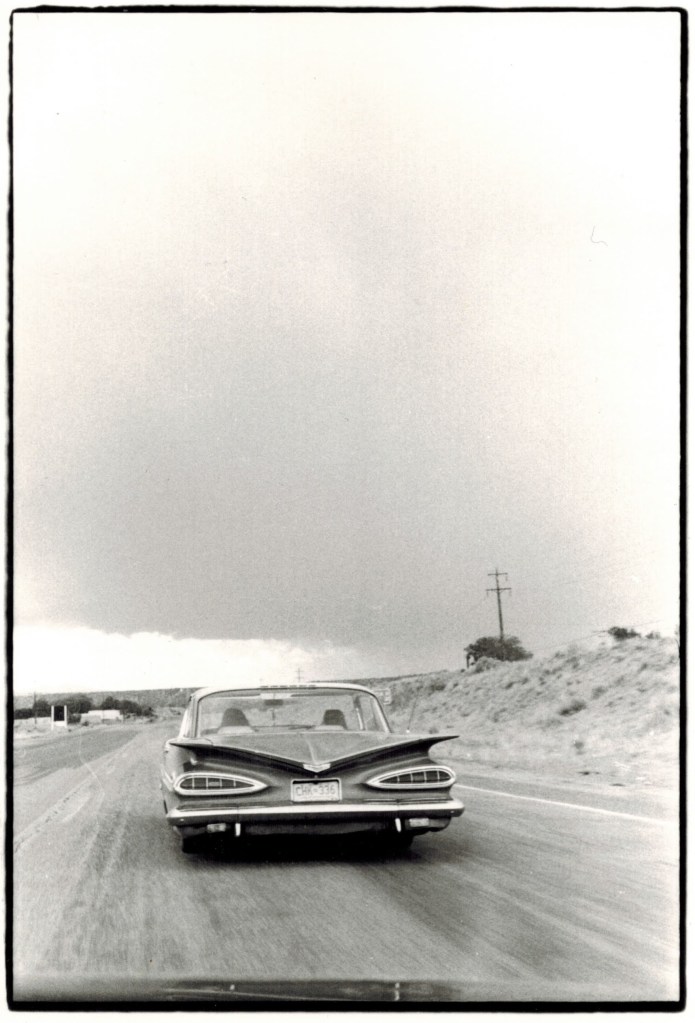
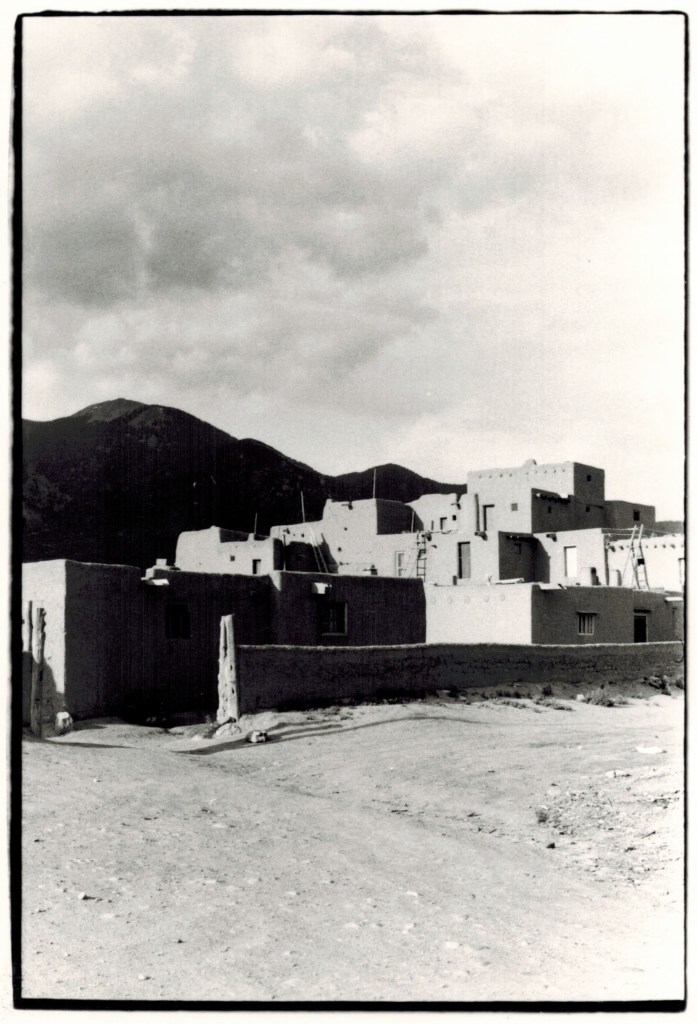
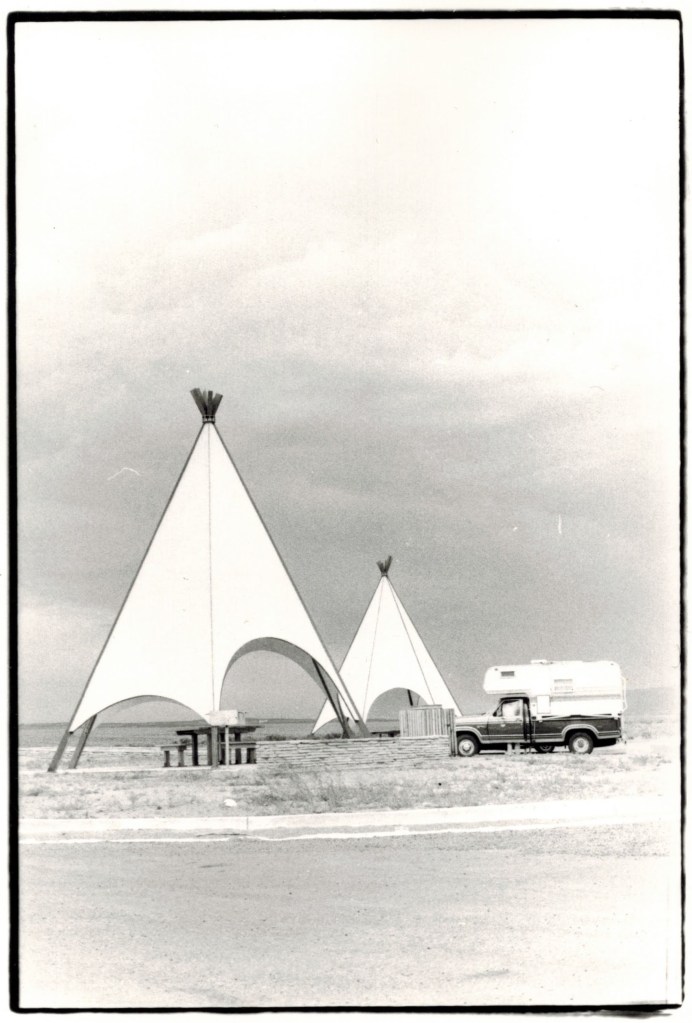
Before Baltiswiler left the US, he made a road trip from New York to the West Coast and back again together with a friend. They travelled Highway 66, visited the Taos people in New Mexico, the Hopi and the Navajo Indians in Arizona, Los Angeles, San Francisco, Yosemite National Park and Chicago.
Düsseldorf
Kunstakademie, Klasse Fritz Schwegler
In autumn 1982 Baltiswiler became a guest student in the class of Fritz Schwegler, at the art academy in Düsseldorf. Thomas Huber and Katharina Fritsch were two of his classmates. Thomas Schütte had left the class earlier.
Baltiswiler created a massive conceptual art work “The Survival Plan”/ “Der Überlebensplan”, which was 8 meters long and 1.2 meters high. He had worked on it for several months. He could realise this huge work in the workshop for graphic design, in the academy. It was meant as a continuation to the “Odysseus” painting he had made one year earlier, in Zurich. It also dealt with different aspects of life. When he presented his new work to his class together with Fritz Schwegler, nobody understood it.
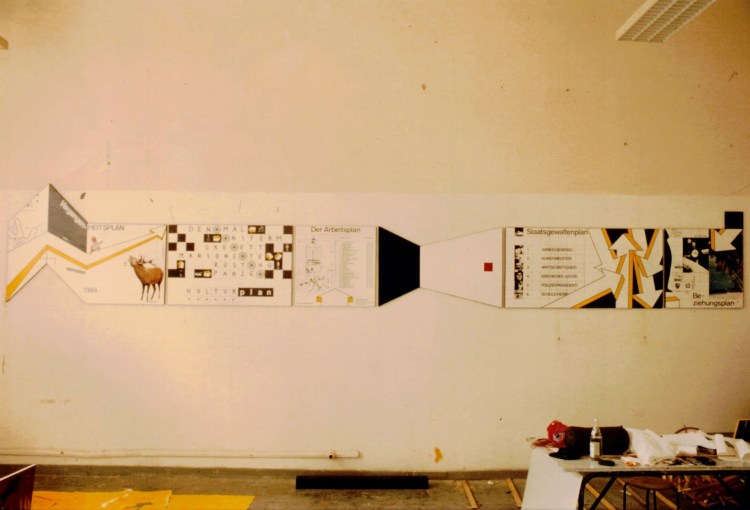
800 x 120 cm, Staatliche Kunstakademie Düsseldorf, Klasse Schwegler, 1983
In 1983 Baltiswiler was officially accepted as a student to the “Staatliche Kunstakademie, Düsseldorf”.
Fritz Schwegler about Ernesto Baltiswiler: “Liebe Kollegen”
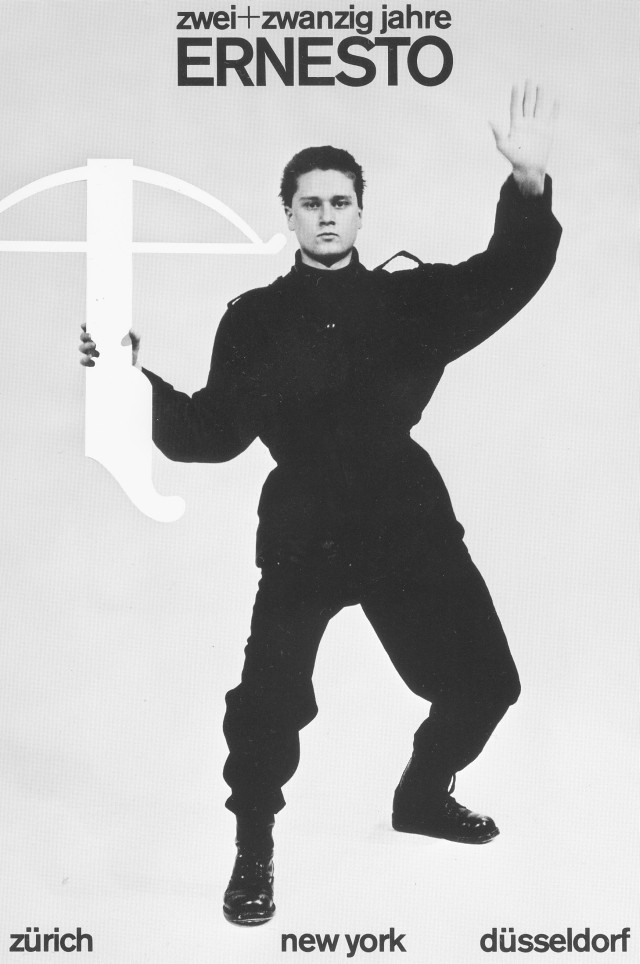
“Situation Schweiz”
Cologne, 1983
More about the ad in the “Kunstforum International” art magazine
“To move from the huge metropolis of New York, to the little town of Düsseldorf, wasn’t easy. I fell into a deep depression. But the art academy was way ahead of the School of Visual Arts. It was the eighties and it was here the art world met. World-famous artists were going in and out of the door of the art academy. They were teachers or guest teachers and many students were on the brink of becoming world-famous artists. The art academy was a melting pot of creativity.
Gerhard Richter was teaching as a professor in painting. I had friends who were in his class and I was there many times, also when Gerhard was there. He came to see his class once a week. All his students were painting only with oil colours. Andreas Gursky, Thomas Struth, Thomas Ruff, Thomas Schütte and Katharina Fritsch were still students. You could meet Joseph Beuys in the corridor, also teaching professors like Nam June Paik, Tony Cragg, Jürgen Partenheimer, Michael Buthe, A.R. Penck, Ulrich Rückriem and many more. Fischli & Weiss were guest teachers. Markus Lüpertz became the principal. In 1985 Jörg Immendorff celebrated his 40th birthday in the“Ratinger Hof”, an artists’ pub very close to the art academy. Everybody from the art world was invited, Beuys was there, I was there. Beuys was the former teacher of Immendorf and he cut the first piece of the birthday cake. The legendary “Ratinger Hof” pub was the first place I had a beer, when I came to Düsseldorf for the first time. I had no idea about the background of this pub. Imi Knoebel’s wife Carmen Knoebel was the owner of the pub from 1974 – 1979. It was The artists’ pub with Sigmar Polke, Blinky Palermo and the musicians of “Kraftwerk” and many today well-known artists as regular guests.
Carmen Knoebel’s own words about the pub “Ratinger Hof” in Düsseldorf: “Erlebte Geschichten mit Carmen Knoebel.”
From then on, I was surrounded by art of a very high quality. Not only in the academy, but also the whole area around me was full of good artists, modern art museums and galleries. This set the bar high for me and I really had to check whether my own art was good or not.”
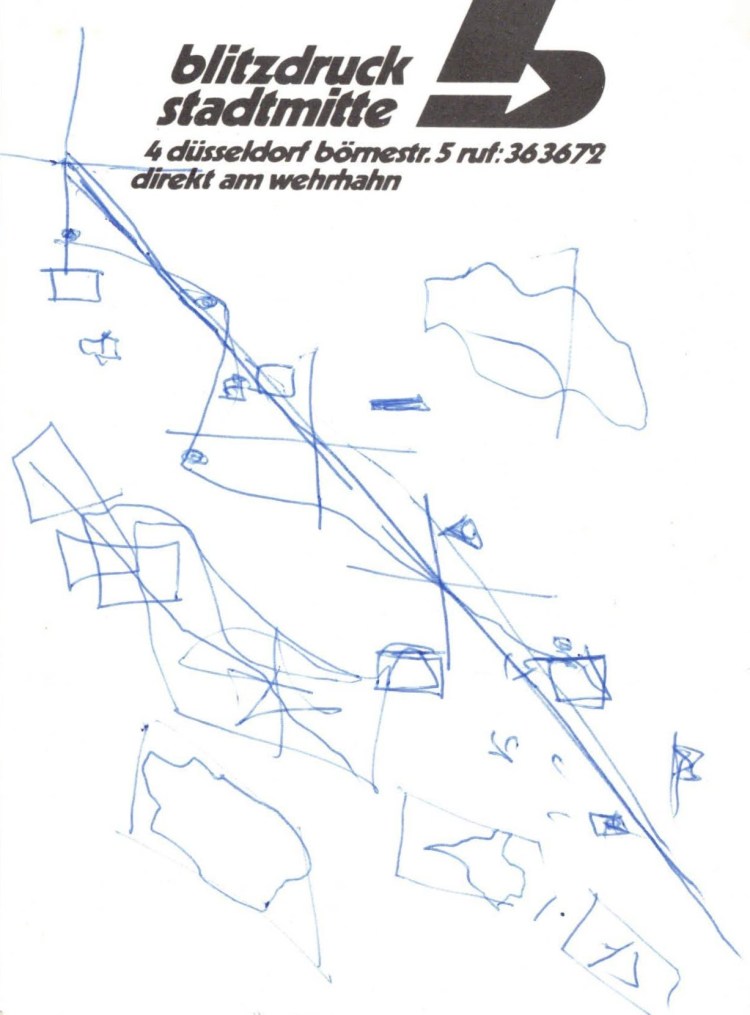
when he tried to explain something to him
Kunstakademie Düsseldorf, 1984
Baltiswiler’s teachers for the first year were Jürgen Partenheimer and Tony Cragg. Baltiswiler started to write, kept on drawing intensively and continued working with his artists’ books.
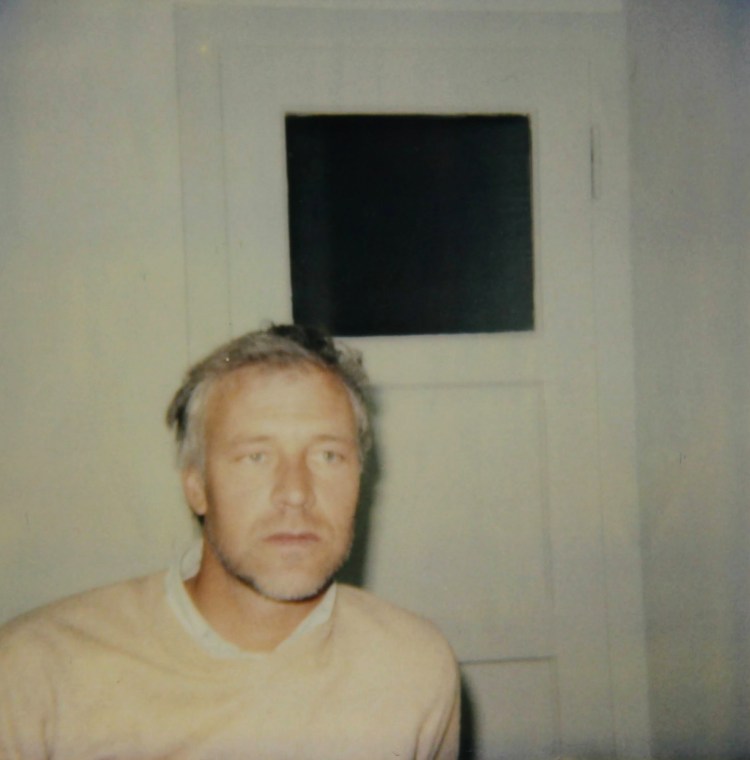
Kunstakademie Düsseldorf
May 7, 1984- 7 days before his 37th birthday
Polaroid photo: Ernesto Baltiswiler
Klasse Jürgen Partenheimer
Jürgen Partenheimer became a guest professor and Baltiswiler joined his class, his 3rd year in the academy. Stefan Kürten was one of his classmates. Baltiswiler made a series of linocuts. In 1984 Jürgen’s class published the artist book “QUARK”.
“I had a fantastic year together with Jürgen and our class. We often went to Amsterdam where we visited interesting art museums and exhibitions and we had very good chats about art.”
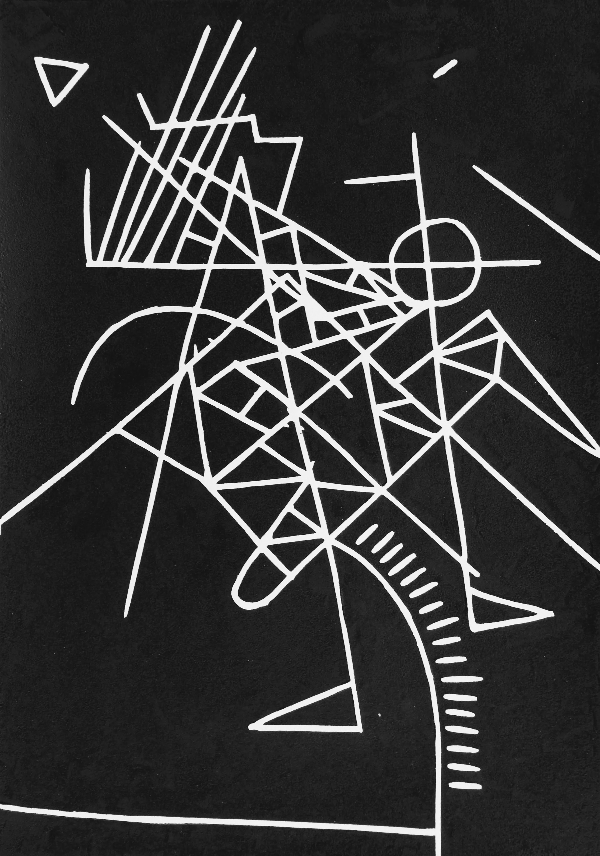
29.7 x 21 cm, EB, 1984

Düsseldorf, 1984
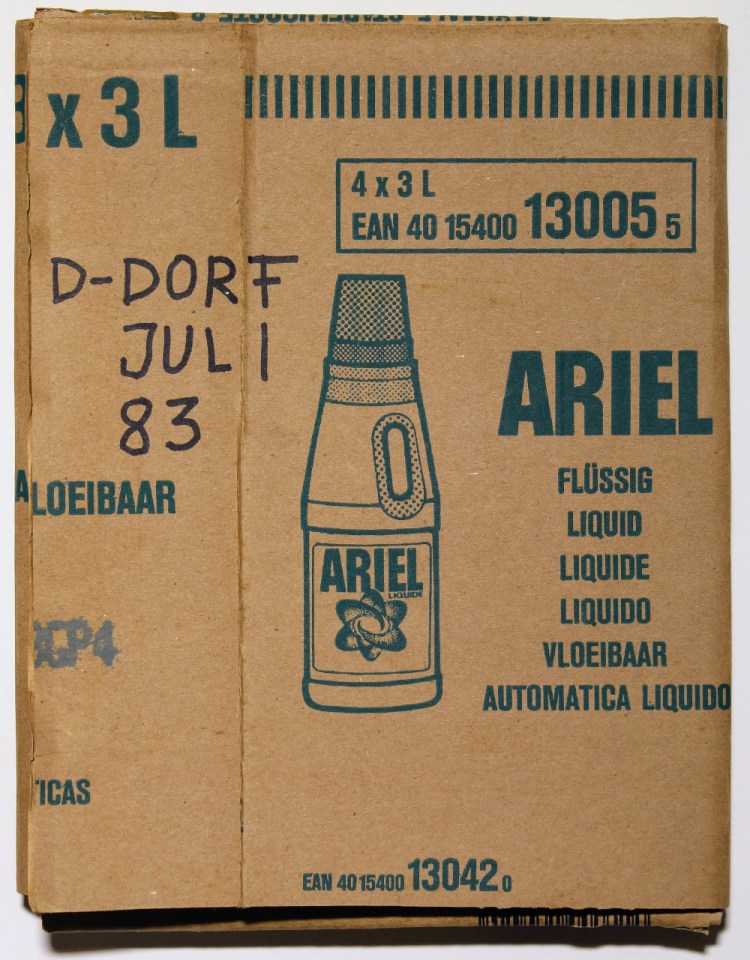
31.5 x 24.5 cm, Düsseldorf, 1983
Klasse Michael Buthe
After one year, Partenheimer left the academy and Michael Buthe took over his class. Buthe was renting a huge former hydroelectric plant in Cologne, where he worked and lived together with his partner the actor Udo Kier. Besides this, he had an apartment in the Old Town in Marrakech, which was his second home. He often invited us to his place in Cologne, not so far from Sigmar Polke’s studio. He cooked for us and after the meal he was belly dancing on the table. Michael also made, like Jürgen Partenheimer, fantastic artists’ books but in a completely different way. He owned an original drawing of Antonin Artaud which Artaud had made under the influence of Opium.
Michael was a good friend of the legendary Swiss gallerist Toni Gerber and the painter Sigmar Polke, who had his studio nearby. I visited Toni twice in the Old Town of Bern, in his small apartment where he lived and which was also his art gallery at the same time- the first time in 1984, together with the art critic Christoph Schenker and the second time with the gallerist Bob van Orsouw.”
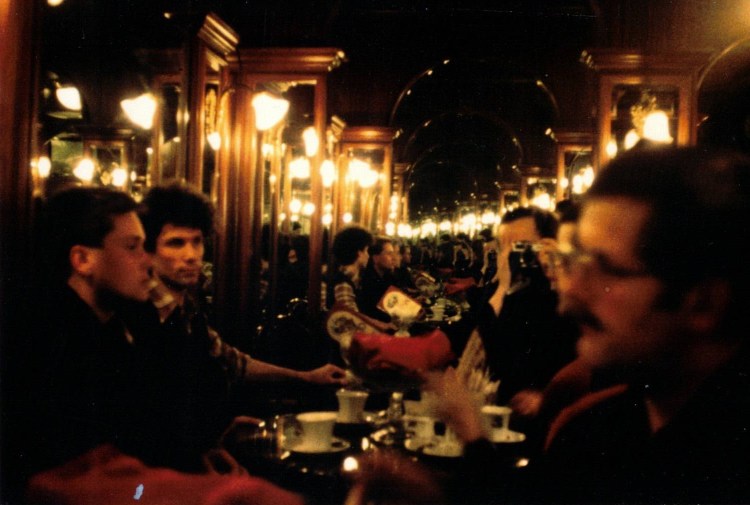
Elisabet Bohm (photo) and Toni Gerber
Bern, 1984
In 1983 the Swedish painter Max Book, who Baltiswiler had met in New York, came to visit him in Düsseldorf. He invited Baltiswiler to Stockholm. Not knowing that he would later spend a big part of his adult life in Scandinavia, Baltiswiler arrived in Stockholm in summer 1983 to visit Max Book, who was on his way to become a famous painter in Sweden. He fell in love with one of Max’s friends, Elisabet Bohm, who he later married. They would stay together for seven years. From then on Baltiswiler started to commute between Düsseldorf, Stockholm and Zurich, continuing his studies in Düsseldorf.
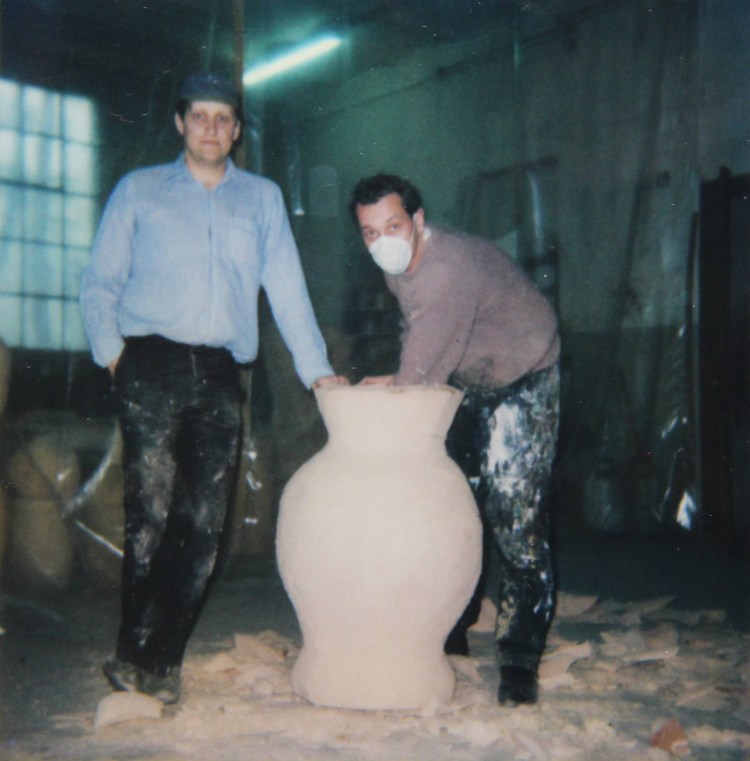
Zürich, April, 1984
Polaroid photo: Ernesto Baltiswiler
To be continued…
↑ Ernesto Baltiswiler